
Luke Carlson founded Discover Strength 20 years ago with a radical premise: treat exercise professionals as legitimate healthcare providers rather than entry-level service workers. His approach elevates fitness professionals while establishing credibility with medical professionals.
At Discover Strength’s studios, team members aren’t just personal trainers—they’re recognized as exercise physiologists, professionals on par with allied healthcare providers. Unlike most personal trainers, the exercise professionals at Discover Strength wear dress shirts, ties, and slacks as one would expect from a healthcare professional.
Consumers have responded to the concept. Discover Strength continues to expand rapidly around the country. It has more than 40 locations across 12 states and Washington, DC, with more on the way.
Carlson holds B.S. and M.S. degrees in kinesiology from the University of Minnesota and studied executive leadership, strategy, and innovation at Stanford University. He’s also an ACSM-certified exercise physiologist and cancer exercise trainer. He’ll become chair of the HFA board on July 1.
The co-author of two books and many scientific journal articles, Carlson is a popular speaker who has presented at The HFA Show and other industry events.
WHAT WAS YOUR FUNDAMENTAL PHILOSOPHY WHEN STARTING DISCOVER STRENGTH?
My fundamental belief is that the exercise professional is definitely the most valuable part of the allied healthcare continuum. That’s my starting point. Yet, historically and currently, we’ve just never treated the exercise professional very professionally. We just don’t have good career paths for exercise professionals.
If you look at most of our big universities with exercise science, kinesiology undergraduate degrees and graduate degrees, they do not mention health clubs, studios, or our industry as viable career options.
They’re steered away from us, and I think that’s because we have a reputation as not being employers of professionals. We might be good employers of low-wage, front-line, part-time staff. We might be good employers of senior executives as a brand grows. But we’ve just never been good employers of exercise professionals. We want to create an empowering environment that not only advances the careers of employees but also raises the bar for the fitness industry as a whole.
So, 20 years ago, I said Discover Strength is going to be a professional services firm not unlike ones for accountants, lawyers, and dentists.

Carlson is a popular speaker who has presented at The HFA Show and other industry events.
WHAT’S THE DISCONNECT BETWEEN EXERCISE SCIENCE RESEARCH AND INDUSTRY PRACTICE?
We have this wonderful body of knowledge—meta-analytical studies published daily about exercise—yet health club professionals aren’t bringing that knowledge to customers. Our customers don’t know about it, and our professionals don’t know about it. This is both a massive problem and a wonderful market opportunity.
Scientific research shows that the average person who goes to a gym doesn’t know anything about exercise. A group of Austrian scientists published a study where they gave 14 statements to regular gymgoers—some myths, some truths, all evidence-based about strength training. The researchers concluded it was a flip of the coin whether gymgoers actually knew anything about exercise.
CAN TRADITIONAL HEALTH CLUBS BRIDGE THIS GAP?
We’re not going to because that’s not our strategy—we’re not trying to do that. This gets back to the basic Michael Porter Harvard Business School strategy: You can’t straddle strategies.
You can’t say we’re going to hire low-level, entry-level part-time people and also say we’re going to be positioned to serve patients of physicians at Mayo Clinic. They just don’t work together.
I understand our health club operators want to be able to hire anybody. They don’t want to have to require undergraduate degrees in exercise science and exercise physiology. They don’t want licensing.
We have licensing in teaching and nursing and every other industry, but we largely don’t want licensing in our industry because it makes it harder to hire people. That’s a strategic decision.
WHAT WOULD IT TAKE TO EARN HEALTHCARE CREDIBILITY?
If you want to be built for it, there are some things we have to do. We have to hire people with undergraduate degrees and graduate degrees; they have to be certified by a respected and recognized exercise accreditation organization. We have to compensate them professionally with paid time off, 401(k) benefits, and health insurance. I don’t know a single nurse, teacher, or physical therapist who doesn’t have all of these things. Most of our clubs don’t offer these benefits, yet we think we’re going to be viewed as part of the healthcare continuum.
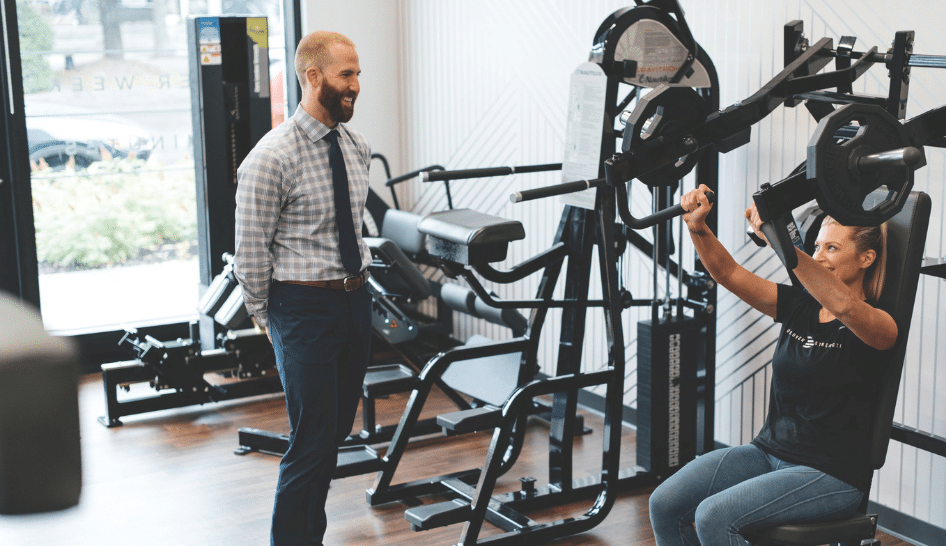
At Discover Strength’s studios, team members aren’t just personal trainers—they’re recognized as exercise physiologists, professionals on par with allied healthcare providers.
WHAT’S THE BUSINESS CASE FOR THIS APPROACH?
Positioning your staff as exercise professionals in the allied healthcare continuum improves staff retention, client retention, ability to compete in crowded marketplaces, and increases willingness to pay, improves loyalty, and creates referral sources from medical professionals. I had a call with a Mayo Clinic physician who said,
“I want to be on your podcast to talk about all the myths around exercise for people that are pregnant.”
Why did the Mayo Clinic physician call me? Well, it’s because she trains at one of our locations and she understands that we have this science-based approach.
HOW DO YOU COMMUNICATE THIS POSITIONING TO CONSUMERS?
One of my best friends, William White, is the chief marketing officer for Walmart—biggest company on earth— and he’s the marketing leader for it.
Brilliant guy. I was listening to him on a podcast, and he said, “Our approach about the brand is this: Be it, do it, and then say it.”
Our issue is we want to say it, but we don’t want to be it and do it. All great brands, to communicate effectively, have to be it first, continually do it, then they can say it.
As soon as you say we’re going to serve the healthcare continuum, this whole allied healthcare continuum, everything you do has to be centered in evidence-based practice, which means we have to eliminate about 80% of the garbage we do in our health clubs. We can’t do what’s popular anymore—we have to only do what’s supported by the scientific research. Now, the good news is there’s a lot of things we can do, but our industry has always been market driven, not science driven. Until we make that fundamental shift, we’re always going to be looked at as recreation.
HOW DID YOU DEVELOP THIS EVIDENCE-BASED PHILOSOPHY?
I was a full-time assistant strength and conditioning coach in the NFL in the late 1990s, and we were very much about, well, anything we do with our players, it’s got to be safe, it’s got to be conducive to their long-term health, and it has to be supported by a preponderance of research.
That was considered very rare at the time. In the world of strength and conditioning, you generally look to whoever was the most muscular or who had the most athletic success; you didn’t look at scientific research. I was sitting in a classroom when I was 20 years old, and I said, “I love studying all of this exercise science. It’s awesome.”
And I knew, at that time, there’s a lot of people who don’t work out in a way that was reflective of all this scientific discovery. So, I said I’m going to spend my career bridging this gap. That formed the vision for our entire company. We want to lead this movement in evidence-based exercise. Health clubs and studios with their equipment and programming are awesome, and all this scientific research is awesome, but they need to be connected.
“We want to create an empowering environment that not only advances the careers of employees but also raises the bar for the fitness industry as a whole.”
Luke Carlson
ONE MARKET-DRIVEN TREND IN THE INDUSTRY IS THE GROWTH OF RECOVERY, WHICH IS A LOOSE TERM THAT COVERS A LOT OF DIFFERENT SERVICES. WE’RE SEEING EVEN HVLPS OFFERING TIERED SERVICES THAT INCLUDE RECOVERY OPTIONS. HOW DO YOU VIEW THIS TREND?
That is a classic example of putting the cart before the horse. Christie Aschwanden, one of the most popular science writers in the world, wrote a bestselling book on recovery. It’s an exhaustive review of recovery modalities that we’re putting into our clubs, and she couldn’t find a shred of evidence that any of it works. She said, “There’s one recovery modality that works: It’s called getting a good night’s sleep.”
Again, we’re doing whatever’s popular and not what’s actually good for the customer. And it’s not my opinion—we have no scientific research to support it. That could change over time, but it is a massive step in the wrong direction, and it hurts our credibility as an industry.
WHAT’S THE DISCONNECT BETWEEN ACADEMIA AND INDUSTRY?
I attend health club events around the world and as many academic scientific conferences as I can. I also publish research on a regular basis. When you go to an academic conference, you hear about new research, but no one ever addresses how this research will be applied. Then you have health club operators who are charged with influencing how people exercise.
You’d think they would turn to scientific research, or that scientists would seek collaboration. There just is no collaboration.
WHAT GIVES YOU OPTIMISM ABOUT BRIDGING THIS GAP?
I think our practitioners want it. People who work in health clubs would love it because we all want to know that what we’re doing is efficacious. We want to feel like we’re experts. We want to feel like we can provide value, and, of course, that value comes not just from our ability to create relationships and foster trust but from sharing what actually works.
The research scientists that I know would love to make a dent in the health club industry. One of the leading researchers in the world messaged me while I was at The HFA Show and said, “I would love to be able to speak at HFA next year. Can I fly over and present?”
CONSIDERING YOUR CONCERNS ABOUT THE INDUSTRY CHOOSING MARKET-DRIVEN SERVICES OVER EVIDENCE-BASED INSTRUCTION, AS HFA CHAIR, HOW WILL YOU TRY TO STEER THE INDUSTRY TO A MORE SCIENCE-BASED APPROACH?
I’m concerned, but I also think it’s up to every operator to determine their own strategy; and I’m not going to suggest that one strategy is right, and another strategy is wrong. However, as an industry, we run the risk of continuing to be viewed as less reputable by segments of the population (this might include the medical community, insurance companies, policymakers, deconditioned people, etc.). As HFA chair, I plan to include voices from academia at conferences, events, and in publications so that operators can start to foster a stronger connection to both the research and the researchers.
WHERE DO YOU SEE THE INDUSTRY’S FUTURE?
Eventually, our club operators will have to decide: Do we just want to be a place where people can hang out and be physically active, or do we want to be a place that says this is how you do evidence-based, intelligent exercise?
We have consciously not chosen the evidence-based option so far. We’re looking for what’s novel, we’re looking for what’s different, we’re looking for what’s popular, we’re looking for what consumers get excited about, but we are not looking at what actually produces results for a consumer. That needs to change. The opportunity is enormous. We’re positioned to serve one of the most meaningful roles in healthcare if we choose the right path.
For more, visit discoverstrength.com.